Plus ça change – March 8, 2026
It’s a lovely day where we live, so I’ll be off on errands and walkabouts. Instead of writing, a quick little bit on the writing process.
For Laveaux: Mother I have my half-baked plot, but I’m pantsing more. See A Holiday I know how it ends, and I know the characters. So, given that I know the destination, I’ve decided to let THEM tell me how to get there. All that said, it turns out that one of the characters (Christophe Glapion, Marie’s main squeeze for the rest of his life) needs a lot of development, but that’s been fun.
Christophe is a Frenchman of noble legacy. They had seven kids, five of whom died young. He shows up, courts her, moves in—against the law, because he’s white. The story has to accommodate all that. So I met Christophe, hung out with him on her back porch, learned a bit about him. I like him, he’s a good man. Fiction, but it jibes with the US census, in order to get around the law he passed for Black so he could live with her. And that has consequences that will show up all through the novel.
I do have the bones of an outline, so I think know what’s the next chapter. I start thinking about how I’m going to craft the scene, manage the conversation, I’m doing my preliminaries to get ready to write it and… HOLD ON.
Marie looks at me. I already know this, she says. Christophe and I have already talked about it. There is NO WAY we would be at this place in the relationship without that.
What I had planned initially, that’s not how these two people work. I have a narrative problem besides, I must introduce by antagonist to the reader. I’m a few chapters in, and he’s nothing but a name. SO…
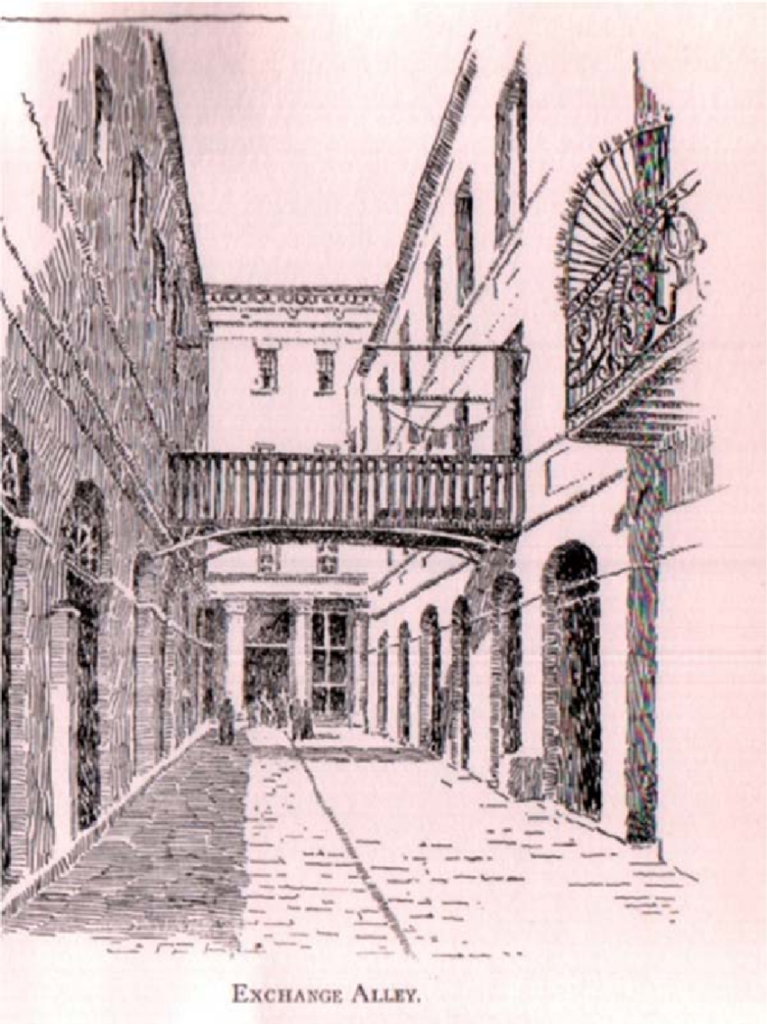
An entirely new chapter appears. Oh is this nice. We get to see 1827 New Orleans, walk through the center of the city and into the business district, walk down Exchange Alley on our way to Hewlett’s Exchange. Good local color that also an opportunity to feed the reader with just how pervasive and “normal” the oppression of people of color is. Hewlett’s Exchange is actually at the end of the alley in the image. The neighborhood and the exchange will be significant locations throughout.
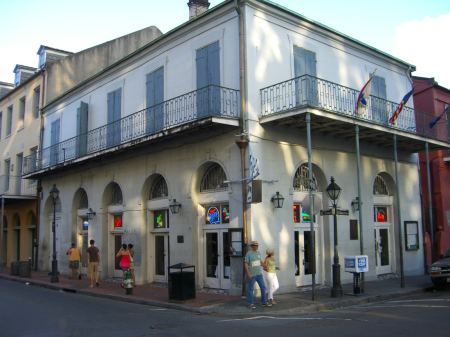
In 1827, Hewlett’s was on the north corner of Chartres and St. Louis. The building is long gone, but kitty corner is a building that was there in 1827. Hewlett’s looked like this, but bigger. Downstairs, an auction hall, a massive bar, and a “club” room for the white business men. It was phenomenally sumptuous. Upstairs, gaming tables, billiards, maybe some hotel rooms. I have a marvelous description from the period of what it looked like inside, and that will make it into the story.
In this—totally unforeseen—chapter we get to see a bit of Christophe’s business interests. We meet the antagonist, the fictional Thomas Kelty Smith from Dancer. He’s re-introduced for new readers, and we get some insight into his political machinations. We get to see Christophe’s reaction to Smith’s manipulations. For new readers, cool, insight into his character. For those who have read Dancer, we see exactly how much he differs from her late husband, Santiago, who was NOT a good person in the story.
None of this was in my original plot. But Marie made it abundantly clear how this was gonna work. I may know the destination, but she and Christophe know the meanders of the river that will take us there.
Off I go into the day… it’s springtime here. Cheers.