Plus ça change – March 3, 2026
A novel has a protagonist, and a voice. This voice is the message, the tone, the point of view that characterizes and fills the novel, typically from the protagonist. Marie certainly has that voice, that of a powerful woman subject to oppression, and her no-nonsense choices to fight back, to be herself regardless.
That’s not the voice I’m talking about. I’m talking about actual sound.
Busy writing chapters for Laveaux: Mother, I come to the conclusion that I have done an inadequate job of conveying what people sound like.
The motivating factor was a note I tossed into a building chapter. CHARACTERIZE POPA’S VOICE. That’s true. But what? I finished a complete novel in which he is a relatively significant character, and I never did this? Yep. The sound of his voice really doesn’t matter that much in the first novel. In this one, it does.
I’m very good at adding adjectives to describe the emotional content of a voice: cold, sad, determined, bright, serious, angry, upbeat, fearful. I love adjectives. When I see these words I can hear that emotional quality in the tone. I hope you do, too. But is it a bass voice, a soprano, an alto? What is the timbre, the resonance. Not emotion, I’m missing the physical characteristics of the sound. Is it thin, resonant, vibrant, lush, flat…
I spent the morning going back over stuff, seeing what I did. I an even see how this desire grew. Earlier, I wanted to characterize the brilliant babble of laughing children, like in a playground. Spent some time hunting for the right word, and it is from music direction, vivace.
I don’t want to use musical terms everywhere, but I see the lack. I’ll probably go back into Dancer and do some minor tweaking. Marie is and should be a contralto. She’s a tall woman, she has a low-pitched, resonant voice. I’ll use the word “contralto” once or twice, but mostly—when it fits—I’ll use less formal descriptive words: husky, deep, sultry.
In Mother, her Popa (Charles Laveaux) is a more significant character. We know a little bit about him historically. We know whom he was married to, that she was very well off, that he was a real estate speculator. He owned a grocery store, and I know where it was. The building is actually a historical monument of sorts. You can’t go far in New Orleans without finding a building with a plaque.
At one point in time or another Charles’s name is on various properties in the Vieux Carré and in the development of Marigny. The family owned slaves. He was successful, and he also went bankrupt. After his wife died, their kids sued him for cheating them out of their mom’s estate. BUT… there is one other tidbit.
After he died, a group of younger men met in the back of the grocery store. The man who owned the property has the same last name as his late wife, so I suspect he was a nephew. They all knew Charles. The chief instigator ended up in a life-long relationship with Marie’s daughter, Charles’ granddaughter.
On that day these young men wrote the charter and founded the Societé d’Économie et d’Assistance Mutuelle—the Economy and Mutual Aid Society. I believe Charles was their inspiration. One of the first formal acts was to accept the gift of a portrait of Alexandre Pétion, the first president of the Haitian Republic, from Charles Laveaux’s estate to the Society, to hang in their small meeting hall.
I read a lot into that. It’s fiction. But I think Charles was an outspoken advocate for the rights of free men of color. I suspect he railed, fulminated, proselytized, agitated. I suspect he was an activist and mentor to a group of men who listened and believed in his message.
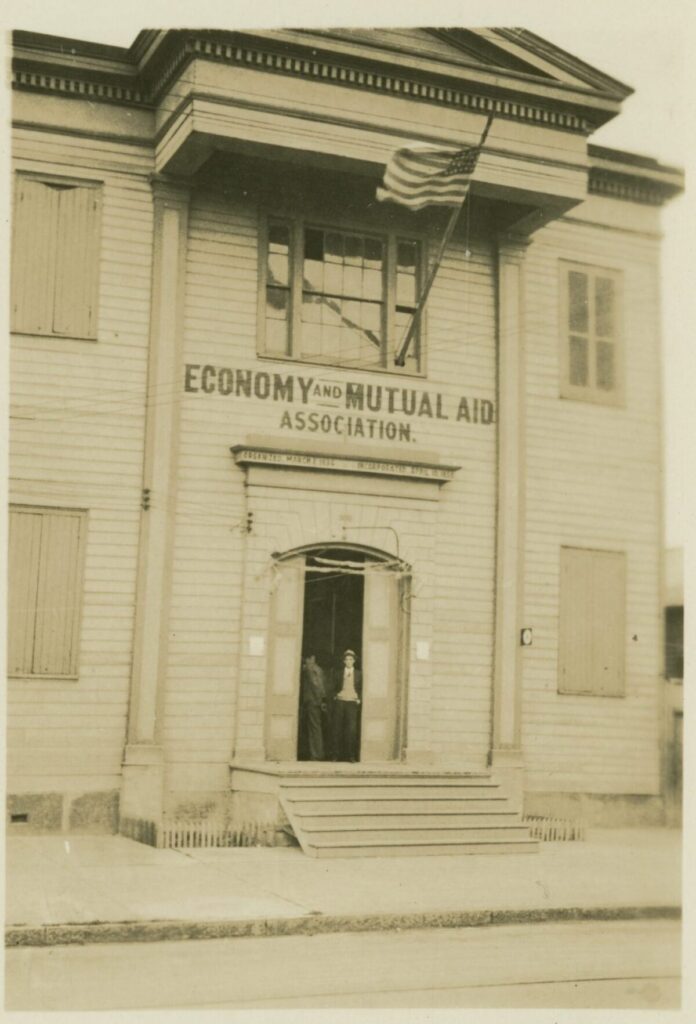
And after he died, those men gathered to remember the old man, and to do something in his honor. So the Economy and Mutual Aid Society was born. By the time they formed the society, the oppression of free people of color by white Americans had become very, very real. So, they thought, let’s help each other.
I’m sure I’ll write more about Economy Hall. They don’t come into play for another few years. But that organization was a force for astonishing good in antebellum New Orleans. The scene I’m working on, well Popa is there. So are his young acolytes. And I know what’s coming. Hence…
CHARACTERIZE POPA’S VOICE.
Two hours later… having thought about a few major characters, and what they sound like, I can now hear Charles. I have a reference model for a modern voice that I can use as a pattern. I can go hear that voice, then describe. Because his place in the narrative is highly dependent upon the power of his speech. An orator can pitch (literal and metaphorical) his voice to the needs of the message and the needs of the audience.
Her father harrumphs. He switches his voice to the chiding tones of a friendly pastor. Correction administered, he returns to preaching, the rich, resonant baritone and the hint of a sing-song cadence carrying the power of his convictions.
Like an organist, I can push the buttons. What you hear, well, that’s inside your head. But you might hear Medgar Evers, Barbara Jordan, Muhammed Ali, Jesse Jackson, Shirley Chisholm, Malcolm X, Angela Davis. Some are bombastic. Some are plain and straightforward. But history is filled with powerful orators from Black America.