Plus ça change – March 30, 2026
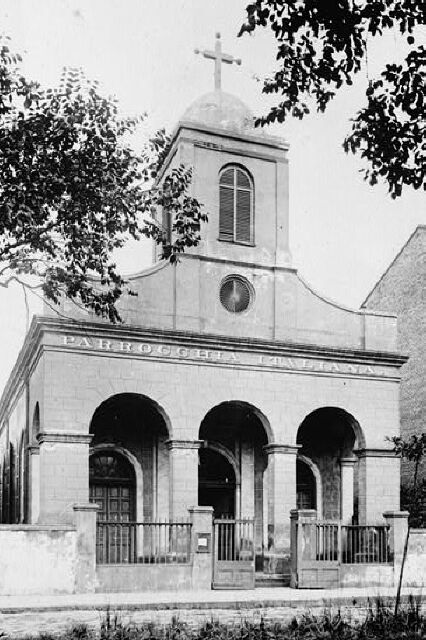
On Dec 27, 1827, Père Antoine dedicated a chapel in New Orleans, to Saint Anthony of Padua. It looks a bit different today than in 1827, but it is still standing, at the corner of Rampart and Conti. This was the second Catholic church built in New Orleans, the first being the cathedral. By itself, interesting historical tidbit, but, honestly, big whoop. Except.
This place was built for one purpose: to get the funerals for yellow fever victims out of the cathedral. No one knew what caused this horrific disease, and there was a widespread fear of contagion. The city (read rich white folk) demanded that funerals of fever victims be elsewhere.
There were three large doors facing onto the arcade in front. The only people allowed inside, once it was in use, were the priest and altar boys. Mourners had to stay outside and watch through the doors. There were no pews. The cemetery was literally across the street out back. A side door went to an alley, to the cemetery. Neat, sweet, complete, get them in the ground quick. The chapel was in (then) the back of the city and out of the way. Where poor and free people of color lived.
To my mind, this was mostly a class division, not race. It was called The Stranger’s Disease because people from elsewhere (mostly immigrants) were far more likely to get the disease. So this was the place for funerals for diseased poor people. The local population were called “acclimated,” unlikely to get it. What they didn’t know was the locals got the disease in childhood, lived or died, and the survivors were immune.
But once this church was up and running, a few years later the bishop said “baptisms and weddings for Black people will be in this chapel.” The official Church was racist and segregationist. In about 20 years the Black community petitioned the bishop for their own parish. See The War of the Pews. Reading between the historical lines, between 1827 and 1847, the Black community was thrown out of the cathedral, where the good white folk worship. Culturally, New Orleans in these decades is on a long slide toward the American brand of racism and slavery. Without doubt the Catholic church was complicit.
Although such a dedication is usually performed by a bishop, that man was in Saint Louis. So Père Antoine performs the ceremony. He is 79 years old. He was famous for his true Christian spirit (acquired in his later years). So was Marie.
At the same time, the city had a genuine ecumenical spirit. There are a couple of historical figures, younger than Père Antoine, who carry his mantle.
That’s history. What I want in my story is to highlight the OTHER side of the class/race coin, that ecumenical spirit. And I want to explore Marie’s relationship with the elderly man. So, fiction.
She’s at this dedication. I’m going to have Parson Clapp, present. He’s the Presbyterian minister of “The Strangers’ Church,” famous for his sermons and his acceptance of everyone. And Judah Touro, founder of the first synagogue outside the original colonies, financial supporter of the Presbyterian church, which houses his free lending library. So I’m making him and Clapp friends.
What I want the reader to experience is an informal cabal: the collection of a Voudou priestess, a Catholic priest, a Presbyterian minister, and a Jewish merchant all of like mind. Contrast the (much later) bishop, who is a slave owning racist. But this chapter is Marie taking care of her very old teacher, on the backdrop of an event (the chapel dedication) that reveals the tension between acceptance and division that is the turmoil going on in New Orleans, and that will tear the United States apart in another 35 years. That is why this scene.
So of course, being me, I go look up the official Catholic ritual for dedicating a church. And boy do I NOT want to bore the reader with that. But the potential opening, the so-called Solemn Entrance, is perfect! So I turned the chapter on its head (for the second time), and instead of Marie and Christophe walking the old priest home to his hut, they meet him and walk him TOO the chapel, participate in the opening solemn entrance, and then the baby is fussing and she leaves with Christophe. I get everything I want, and do NOT spend two and a half pages explaining something to you that you don’t care about and that, honestly, has nothing to do with the story.
Thus I save the reader the dedication Mass, the homily, the prayers, etc. And me from having to write it. The point is about Marie and her little family, and her relationship with and care for Père Antoine. Oh, and Christophe’s “you really need help” discussion, because she DID want to walk him home, but the baby got in the way. That becomes absolutely natural, flows right out of the event, and right into the next chapter.