Plus ça Change – April 11, 2026
The chapter I’m working on is very much “author’s conceit,” in that I’m jonesing to write this. It is history that presents a wonderful vehicle for the narrative.
Abraham Lincoln visited New Orleans twice as a young man. There is legend that on that second trip he consulted a Black woman, a fortune teller. There are a couple of other legends about his presence in New Orleans, and I’m going to take full advantage of them to weave into the story. For all of this I owe a debt to Lincoln in New Orleans by Richard Campanella. His is a thoroughly researched non-fiction look at what we know—and what we surmise—about Lincoln’s two trips, from the dock in Indiana all the way to The Elephant. He writes about this on a backdrop of what New Orleans was like at the time. For me, this is an outstanding resource. I get facts, as distinct from legends, and local color I can work into the story along with the legends.
So how does Marie meet him? Ah, this is the most fun part of writing. I get to make it up! But it must be plausible.
Lincoln is a Kaintuck, the New Orleans word for a backwoods hick. On his first trip he is 19, a gangly teenager from Indiana wearing ill-fitting clothes. It is probably his first trip out into the wide world. Going to New Orleans was a rite of passage for a young man. Visiting the city was “to see the elephant” because it was one of the great cities of the world. One stop on the young man’s tour in 1828 would be the place that we call Congo Square, to see the slaves singing and dancing on a Sunday. This was a regular tourist destination, and the presence of Kaintucks watching the show has already appeared in the novels. Because it’s historical, and because I plot in advance. I was setting this up.
Marie has no love of Kaintucks, as a group they’re foul, loudmouth, dirty cretins who hoot and holler. But on this occasion a young man catches her eye. He is the spit and image of Père Antoine: much younger, much much taller, but the resemblance is remarkable.
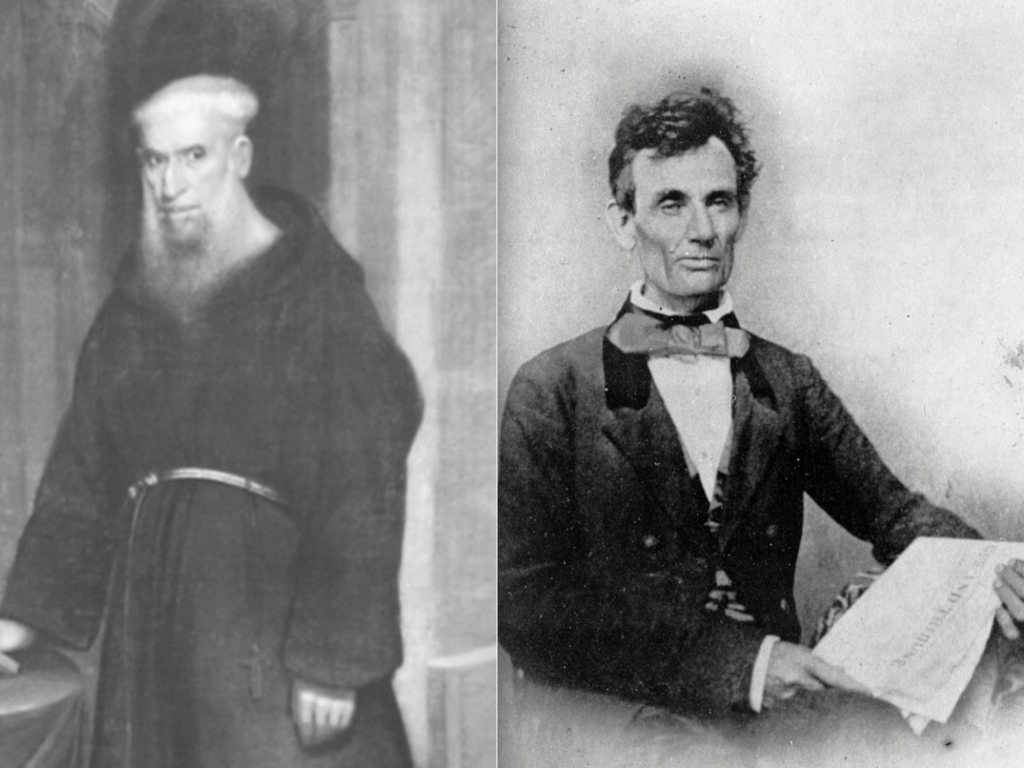
That’s all I need to get started. I have a whole chapter, two in fact, one for each trip, and the plausible rationales for the conversations they have, why he comes back to find her three years later, and all that good stuff. There is a historical record of a recurring dream that Lincoln has, it will be in both chapters.
In 1828 he would have, almost without doubt, stood on the side of Congo Square and watched Marie dance. He (by legend) roomed in a home on the same street where she lived, three blocks away. A home owned by a free colored family. And in 1831, says legend, he visited a Black woman who told his future.
Because, for real, Abraham lived in a free state, and he was probably already leaning toward the idea that Black people should not be slaves. But the American society he grew up in said they were savages. You know, like Haitian immigrants today. On the 1828 trip he experienced both sides of this. Shortly before he got to New Orleans, he was attacked by a band of runaway slaves trying to steal his cargo. Yet, wandering New Orleans, he also saw a vibrant multicultural, multi-lingual, multi-racial society where almost one third of everyone were free people of color. The city was filled with artisans—his word “mechanics”—intelligent, educated, living lives and adding to the ambiance of the elephant.
In the three years between his two visits he sees the impact of crushing American racism, and how it destroys the potential of the “Black mechanic.” He was not an abolitionist, he emancipated the slaves as a war strategy, not philosophy. But my story is about Marie, not Lincoln, so we won’t go there. I want him to see New Orleans for what it is (was), and I leave it to the reader to imagine the lessons he went home with.