In The Flow of Time – June 28, 2025
My colleague writers make fun of me when I say I have this strange devotion to facts in my fiction. 🙂 I’ll take that as a badge of honor. I’m restructuring the end of this novel. I had a serious narrative problem, the bad guy just vanishes. That’s not gonna work. The story needs closure related to a VERY unpleasant character.
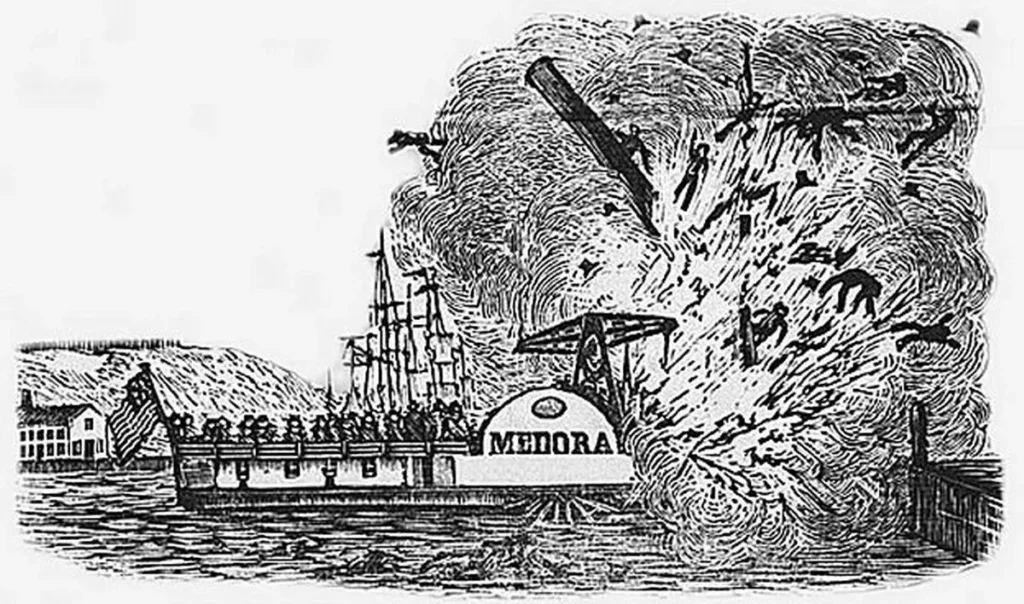
So he’s going to experience a steamboat explosion up close and personal. To that end, I add new chapters, and restructure existing. This is a non-trivial tweak with lots of lessons to the Plotter writer (me). All that effort into crafting a plot from beginning to end, all the chapters, the who what when where why of each… be ready to kiss it good bye. I was wrong, but the nature of the error is that I didn’t think it through far enough from a story-telling perspective. I write the story, I get to the end, and “Self,” I says, “we have a problem.” All the research and learning and ambiance and color, it’s all still good. I need a better ending. Sweet.
So, what does this have to do with flexible facts?
One of the tweaks in the narrative involves a police raid on a Voudou ceremony. This really happened on August 15, 1820. I have the date, the approximate location of the house, that the attendees were slaves and free people, there are descriptions of some of the paraphernalia (which meshes nicely with what I’ve learned about the underpinnings of Voudou).
I also have descriptions of similar raids in 1850. The priestess involved was Betsy Toledano. She was a vocal resister. Marie Laveaux’s name is not on the list of the arrested. But she sues to get one of the statues that the police seized. So she is involved, in the middle or tangential, in 1850.
In the story, all this turns into…
◊ My description of 1820 is right out of newspaper reporting from 1850, racist and vile
◊ I set the 1820 raid in a good place, consistent with history
◊ I make the house (fiction) an early New Orleans “Shotgun” house (historically consistent)
◊ The found paraphernalia (historical) informs the nature of the ceremony (fiction)
◊ I moved the raid to September 18 (better timing for the story)
◊ Some historical weather events (lighting strike on the church bell tower) move to accommodate
◊ I use the (likely) historically fictitious Sanité Dédé as Marie’s co-priestess
◊ Marie is present and arrested (she wasn’t, but I need it for the story)
◊ I give Betsy Toledano’s 1850 words to Sanité Dédé in 1820
History informs fiction, but I have my fun with it. Betsy is likely to show up when the story gets to 1850, dunno, haven’t plotted that far out. 🙂 Laveaux: Dancer ends in 1823.
So, yeah, flexible facts, but facts; 19th century news reports seen through a 21st century lens, move them around as needed for a good story. (“We owe allegiance to the truth, not the facts.”)
HOWEVER…
My novels are filled with historical people. For main characters, if I know genealogy-like info (birth date, death date, etc) I want the novel to be factual. It would be a LOT easier to just kill off the antagonist in the steamboat explosion. “And then he died.” But (fact) he lives for years.
So (fiction) I’ll have him parboiled, disfigured, crippled… dunno. Haven’t written it yet. I don’t have an historical explosion, so I’ll make that up. I’ve done my research on steamboats and explosions, I’ve got contemporaneous descriptions of the aftermath. I can make it all up, and keep it historically consistent.
But he will survive, and disappear from this story. I can only stretch the facts so far. It’s a strange set of internal constraints. I can make up any end I want, I just can’t change the day he dies.
IT. IS. HISTORICAL. FICTION.