Plus ça change – April 2, 2026
Real life is not neat with solid lines, clear boundaries, and binary conditions. Marie Laveaux owned slaves. That’s a fact. Many free people of color owned slaves. It was common. As horrific as this is to our sensibilities, this was the air within which all these people walked.
I’m of the opinion that it is more class than it is race. This is urban slavery. There were two primary reasons for owning slaves in the city. One was to have servants. There were butlers, washerwomen, cooks, maids, etc. The other was as investment. Slaves were property. If you owned a slave, you could job them out. They get paid wages, and the master keeps those wages. Over time, with learned skills and maturity, your investment has greater value. Like real estate speculation, you could sell at a profit later on. You could use a slave as collateral on a loan.
Of course, the other side of that coin applies as well. A slave who was intractable, more trouble that they’re worth, might be freed gratis. As a slave gets old, he or she becomes less valuable. They are sometimes freed to get rid of the burden, dumped in the street, effectively.
Slaves are human chattel. Free people of color owned slaves. Marie is my protagonist, her mother and her grandmother were slaves. She has seen the horror, and she’s a smart woman. How do we rationalize her owning slaves?
We know she and Christophe bought and sold human beings. Several over the years, and a couple will show up in the story. There is no record that Marie owned slaves before Christophe moved in with her. Christophe, as well as his father and mother did. The primary database I have goes up to 1820. After that the records I have are spotty. But without doubt, Christophe trades in slaves. I suspect it is a business proposition – he’s jobbing them out. But that’s suspicion.
Eliza was their first purchase after they became a couple. On March 14, 1828, Christophe pays $215 for “an orphaned Negress named Eliza aged eight years.” I know when, I know the name of the man selling her, a dealer in human flesh. Eliza was probably ripped from her mother somewhere in the southeastern United States and shipped to New Orleans for sale. Separating a child from her mother was illegal in New Orleans, so she has to be sold as an orphan. Eight.
Eliza lived with the Laveaux family for more than 20 years. We have no idea what Marie and Christophe were like as masters. So we cross the divide from fact into fiction. There are other “realities” that would explain the circumstance, but this is the one I pick, to tell my story, what I see as truth.
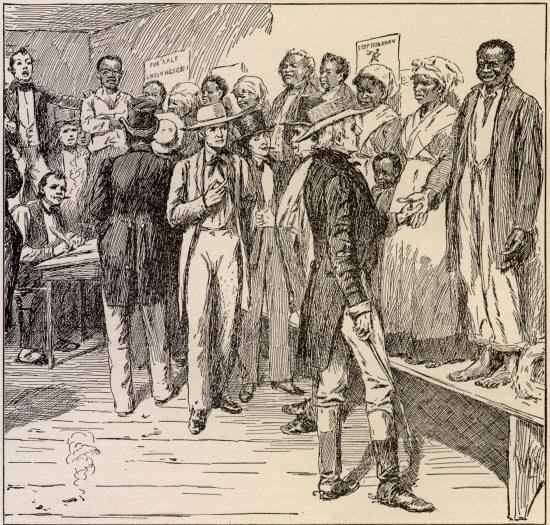
For narrative tightness, I want Marie to make the purchase, not Christophe. Why would she be at a slave auction in the first place? Again, history gives me a factual answer. This is a decade or more downstream, but moving this in time is trivial. A hairdresser (Marie is a hairdresser) calls on a client at a very high-end hotel that is also a business exchange, and stumbles upon a slave auction.
“I stood for some time watching this market. I saw people, both young and old . . . as white as white could be and as black as black could get, put up and sold to the highest bidder in this elegant hotel. . . . Some seemed satisfied with their lot, and others . . . grieved to death. . . . I have often wondered to myself how men can speak so much on the glorious cause of freedom and talk of this as the land of liberty, while they are daily and hourly trafficking in human beings.”
The approach I’m taking, because I need heroes too, is that Marie is rescuing this child. The circumstances are evil, the horror real, there is no good way out. So she purchases this poor child to save her from an evil fate, takes her home, and treats her like family. It is what it is. Eliza will be nanny to Marie’s children, cook. But also treated like a daughter. That doesn’t change reality, the law is the law. Eliza is a slave and Marie will never be able to emancipate her. The Americans have made that all but impossible.
A huge amount of my plot cascades from this choice, this event. I have known about this problem for literal years, as I researched and pondered. How do we have, in the same person of Marie Laveaux, legendary kindness alongside buying an eight year old little girl and keeping her for decades.
I decided on this path a long time ago, and I have to say, I’m excited to finally get here. This is a pivotal chapter, and it’s gonna take me some serious effort to craft it into the piece of beauty and understanding it needs to be. There should be tears.
And he’s off.